
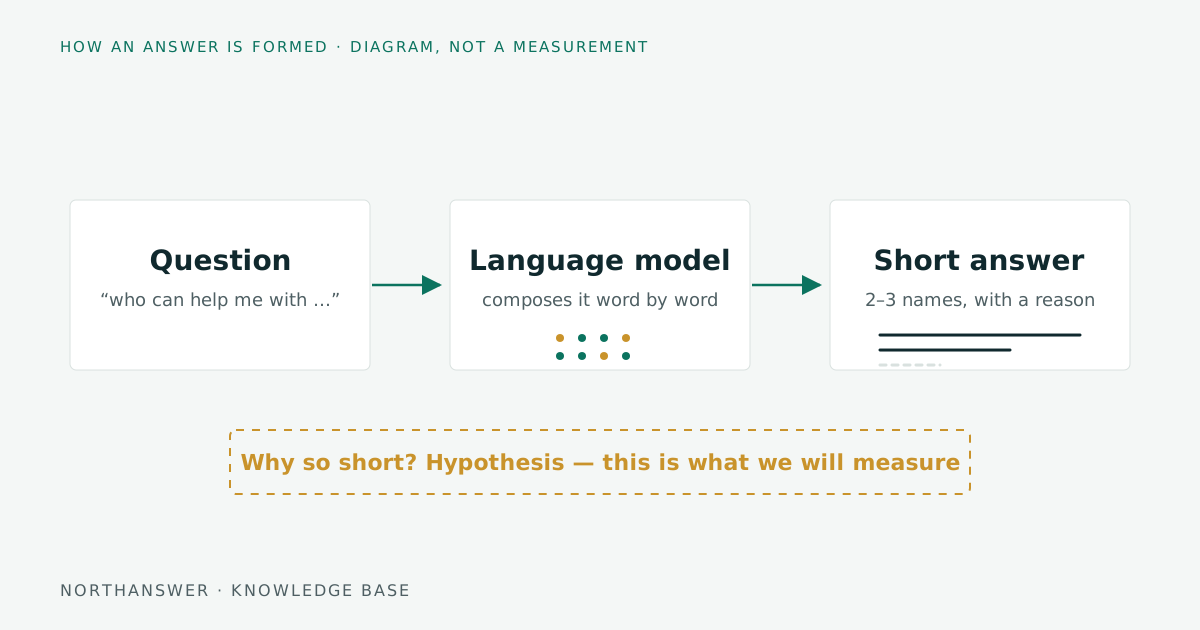
Is it actually true that AI assistants only name a few businesses?
Honest answer: that is our working hypothesis, not an established fact. Type “who can help me with…” a few times yourself and you will usually see a short list of two to five names with a reason per name. But “usually” is an impression from our own trying, not a measurement across hundreds of questions and multiple assistants. A firm sentence like “AI never names more than two businesses” would claim more than we can support. That is why this article is written in question form, and why we mark each explanation below as an assumption, a vendor statement, or something we will measure ourselves.
How does a language model compose an answer?
A language model does not look businesses up in a list and pick the best one. It is trained on very large amounts of text and composes an answer word by word, based on what is most likely to follow in that text. Two properties of that process are described by the vendors themselves. First, the knowledge has a boundary: in its models overview, Anthropic defines the “reliable knowledge cutoff” as “the date through which the model's knowledge is most extensive and reliable”. Whatever appeared after that date, the model only knows if it searches the live web. Second, there is chance involved: according to the API documentation, results are “even with temperature of 0.0 … not fully deterministic”. Both pages are technical documentation without a publication date, opened by us on 1 September 2026 — not research, but statements by the vendor about its own product.
What this means for business names is a line of reasoning, not a measurement: a name that appears often and consistently in the text the model was trained on (and in whatever it may find live) has a better chance of turning up in an answer than a name that is rarely or inconsistently described. How strong that effect is, we do not know.
Why would an answer be short?
We have not found a strong primary source for this. So we list three possible explanations, explicitly as hypotheses:
- Hypothesis 1 — the form of the conversation. A chat answer is not a results page with ten blue links; an assistant gives a readable answer, and a readable answer rarely contains ten names.
- Hypothesis 2 — the question itself. “Who can help me with…” asks for a recommendation, not an overview. A question like “give me a list of twenty providers” probably produces a longer answer. Whether that is so can be tested.
- Hypothesis 3 — the tuning of the model. Vendors tune their models towards useful, concise answers. Their documentation says so in general terms, but not as “name at most three businesses”.
Which businesses do end up in such an answer?
Here too: assumptions, not measured facts. It stands to reason that businesses that are described clearly and consistently in many places — what they do, for whom, where — come back more often than businesses about which little or contradictory text exists. It also stands to reason that the arguments the AI gives (“specialised in…”, “well reviewed for…”) come from somewhere. But whether that is how it works in your market, and which sources are decisive, you can only see by measuring it: asking the same question repeatedly and recording, per answer, who gets named and for what reason. The same question seen from your competitor's side is in “Why does ChatGPT mention my competitor?”.
What is assumption here and what is measured fact?
| Claim | Status | How we could establish it |
|---|---|---|
| AI assistants usually name two to five businesses for a customer question | Assumption (own impression) | Count per market across 125 answers per question set; report as a number, not as “always” |
| Answers differ from run to run, even for the same question | Vendor statement (Anthropic documentation) + own experience | Record five repetitions per question and show the spread |
| A model only knows what was published before its knowledge cutoff, unless it searches live | Vendor statement (Anthropic documentation) | We note per measurement whether web search was on; we measure both lanes separately where the API allows it |
| Businesses described often and consistently get named more often | Assumption (reasoning) | Compare named businesses with how they are described online — not done yet |
| Short answers are caused by the conversation form, the question or the tuning | Three hypotheses, no source | Vary the phrasing and measure answer length |
What can you do with this right now?
Two things. First: try it yourself, with a few real customer questions, and repeat them — how to do that and what you may conclude is in “How to check it yourself”. Second: make sure that what can be read about your business is correct and consistent — that is useful regardless of how AI answers come about, and it is the only thing you control yourself. Nobody can promise that an AI will then name you; what we can do is measure where you stand.