
Why does an AI assistant name businesses at all?
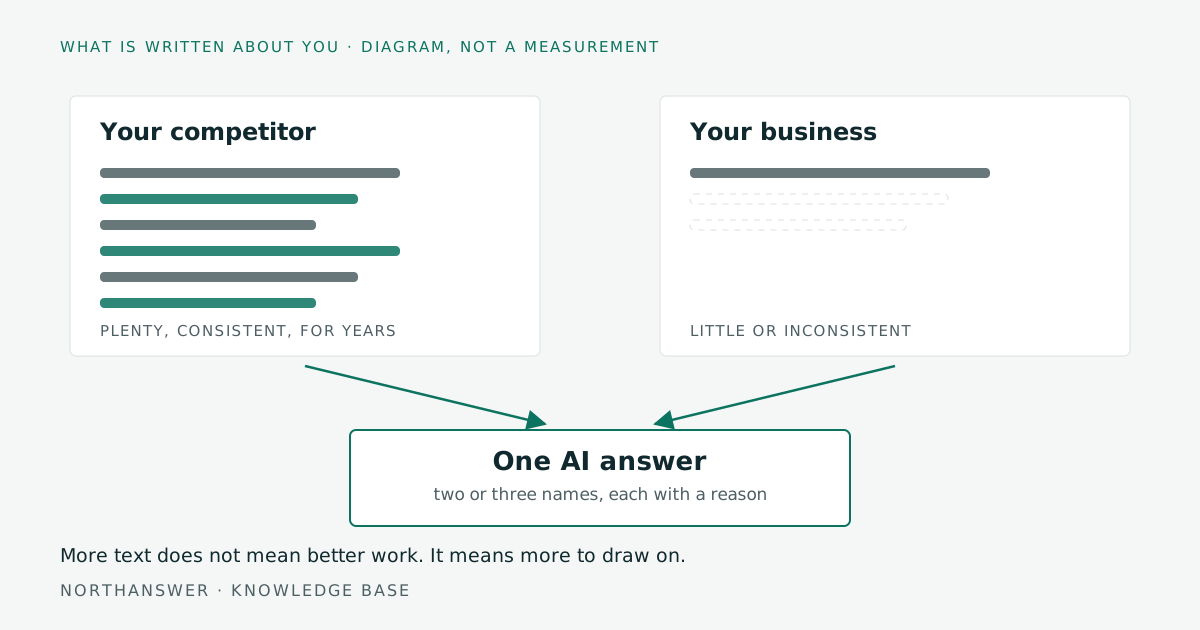
An AI assistant does not look businesses up in a register and pick the best one. It is trained on very large amounts of text and composes its answer word by word, based on what is most likely to follow in that text. Names that appear often, consistently and in clear context have a better chance of coming back than names that are described rarely or inconsistently. Your own website counts, but it is one voice among many: a trade directory, a news item, a forum thread or a comparison page all weigh in without you having any say.
There is also a boundary to what a model knows. In its models overview, Anthropic defines the “reliable knowledge cutoff” as “the date through which the model's knowledge is most extensive and reliable”. Whatever appeared after that date, the model only knows if it searches the live web. A competitor who has been described the same way for years therefore has a head start that has nothing to do with quality: there is simply more, older and more widely copied material about them.
Is that answer a ranked list?
No. A search engine collects pages and puts them in order. An AI assistant does something else: it writes one coherent answer and names the businesses that fit its reconstruction. There is no position one and no position seven. Whoever is in the answer is in it; whoever is not, is missing — and next time the mix can be different. According to Anthropic's API documentation, results are “even with temperature of 0.0 … not fully deterministic”. One answer is a snapshot, not a result table.
Why can your competitor be named without being better?
There are reasons that have nothing to do with the quality of their work. Four common ones — this is reasoning, not measurement:
- More is written about them. More mentions in more places means more text for a model to draw on.
- Their service is described more clearly. “We take work off your hands” is not a service to a model; “payroll administration for hospitality businesses in South Holland” is.
- Their pages are older and more often quoted. Material that has been online for a long time and gets copied by others turns up more often in the text a model was trained on.
- They are one recognisable entity. The same name, the same address and the same description everywhere means one business instead of three half-overlapping versions.
None of these four says anything about who does the better work. They say something about how much unambiguous text exists about someone. That is an uncomfortable observation, but an honest one — and it is precisely the part you can do something about yourself.
How does “I do well in Google” fit into this?
Being easy to find in a search engine and being named by an AI assistant are two different things. A search engine picks pages; a language model composes sentences. Some assistants do search the web while answering, and there a findable page helps. An answer from the model's own memory does not: it draws on what was in the text during training. That is why we measure those two lanes separately where the API allows it. Why they can diverge — and why five providers give five answers — is in “Do all AI assistants say the same?”.
What do you know once you measure, and what not?
| Question | What a measurement shows | What a measurement does not show |
|---|---|---|
| Are you named? | In how many of the 125 answers you appear, split per customer question and per provider | Why the model picked your name — a model does not say that |
| Who is named instead? | Which names come back and how often, with the literal sentence | Whether those businesses have more customers or more work; that is not measured |
| On what grounds? | The sentence you are named in, with an evidence ID so you can look it up | Which source that argument came from; the answer does not state it |
| Does it change? | The spread across five repetitions per question, per provider | What happens next month — every measurement stays a snapshot |
The difference between those two columns is the whole point. You can speculate endlessly about why a competitor gets named; you can also count how often it happens, on which question, at which provider and in what words. The second is duller and far more useful.
How those 125 answers come about, which five providers they come from, and how you can trace every figure in the report is on our measurement method.