
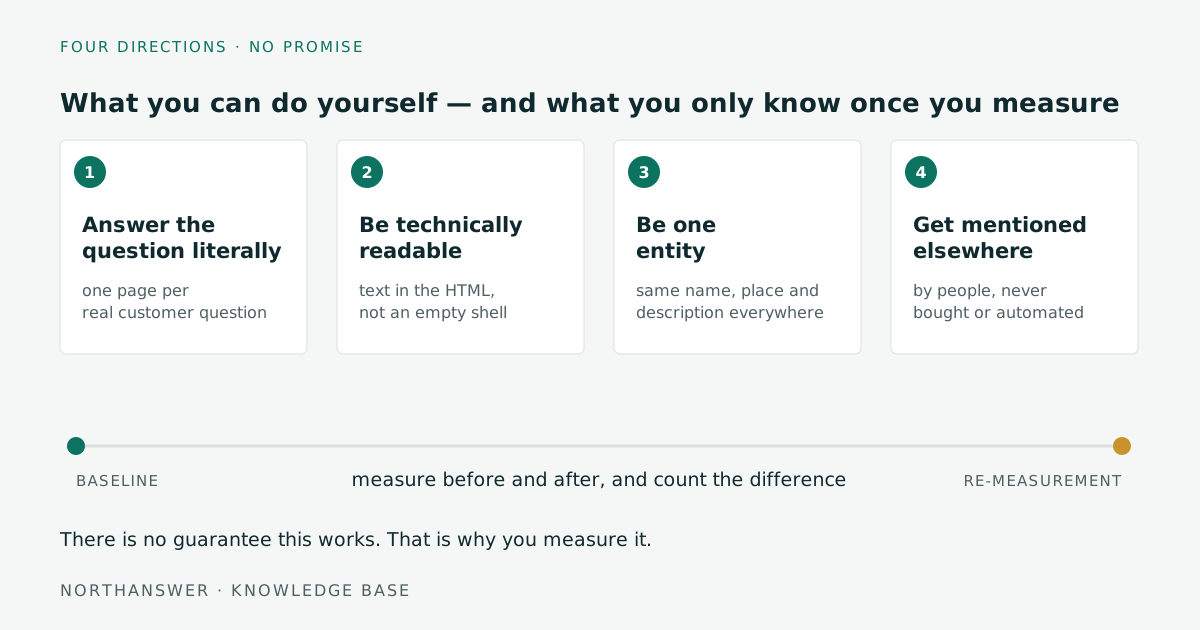
How do you answer the customer's question literally?
Most websites describe what a business offers. A customer asks something else: a whole question, in their own words, with a place and a situation in it. “Who can do the payroll for a café in Leiden?” is a different text from “Our services”. So build one page per important customer question that answers exactly that question: the question as the heading, the answer in the first paragraph, and the details after that — who it is for, where you work, what it costs or why you do not put that on the site.
Why this could help: a language model composes its answer from text it knows, and text that answers the question literally sits closer to an answer than a brochure sentence. What you may not expect: that your page counts straight away. In its models overview, Anthropic defines the “reliable knowledge cutoff” as “the date through which the model's knowledge is most extensive and reliable”. What you publish today, a model only knows if it searches the live web — it can reach the model's memory at a next training round at the earliest, and whether that happens nobody knows.
Why must your page be readable without JavaScript?
Many modern sites only assemble their text inside the browser. A reader sees a tidy page, but a program fetching that page gets an empty shell. So put the important text in the HTML itself: one clear title, headings that are questions, and the answer as ordinary text. Add structured data where it is accurate — an organisation, a service, a frequently asked question that really is on the page — and never invent anything there that the visitor cannot see.
Why this could help: what cannot be read cannot be reused. What you may not expect: that readability is itself a reason to be named. It is a precondition, not an argument. A perfectly readable page about a service that is described nowhere else stays a quiet page.
Who are you according to the rest of the internet?
Look yourself up the way a stranger would: your trading name, your company name, your old name, your town. If you find yourself with three spellings, two addresses and four descriptions, then for a model there is not one business but a cloud of half-businesses. Pick one name, one address, one company number and one description of what you do, and make them identical everywhere: your own site, your listings, your profiles, your invoices, your e-mail signature.
Why this could help: unambiguous text is easier to summarise than contradictory text, and summarising is exactly what a model does. What you may not expect: an effect you can see within a week. Existing text on somebody else's site does not change because you tidied up your own.
How do you get mentioned elsewhere, without tricks?
The hardest part, and the only one you cannot arrange on your own: being mentioned in places assistants read. Think of a trade magazine quoting you, an industry body with a member list, a customer describing in an interview what you did, a local news site, a directory people actually use. That is human work: you ask for it, or you earn it with something worth writing about. We do not do this automatically, we do not buy links, and we post nothing on your behalf. A network of bought mentions is not visibility but a liability.
Why this could help: it is the only direction that adds text which does not come from you — and that is exactly the material a model draws on. Why a competitor can end up being named without being better is in “Why does ChatGPT mention my competitor?”. What you may not expect: a number of mentions after which it “works”. That threshold does not exist, and anyone naming one has made it up.
What can you expect from all this?
| Direction | Why it could help | What you may not expect |
|---|---|---|
| Answering the question literally | Text answering the customer's question in customer language sits closer to an answer than a brochure sentence | An immediate effect: new text reaches a model's memory at a next training round at the earliest, if at all |
| Being technically readable | What cannot be read cannot be reused | That readability is itself a reason to be named; it is a precondition |
| Being one recognisable entity | Unambiguous text is easier to summarise than contradictory text | That other people's old listings change along when you tidy up your own site |
| Being mentioned elsewhere by people | It adds text that does not come from you — the material a model draws on | A threshold after which it “works”; there is none, and bought mentions are a liability |
There is no fifth direction that makes this certain. According to Anthropic's API documentation, results are “even with temperature of 0.0 … not fully deterministic”: the same model can answer the same question differently twice. One better answer after a change therefore proves nothing, and neither does one worse answer. Only a repeated measurement before and after shows a difference bigger than the noise.
How that measurement is put together — which five providers, why five repetitions, and how you trace every figure with an evidence ID — is on our measurement method.